
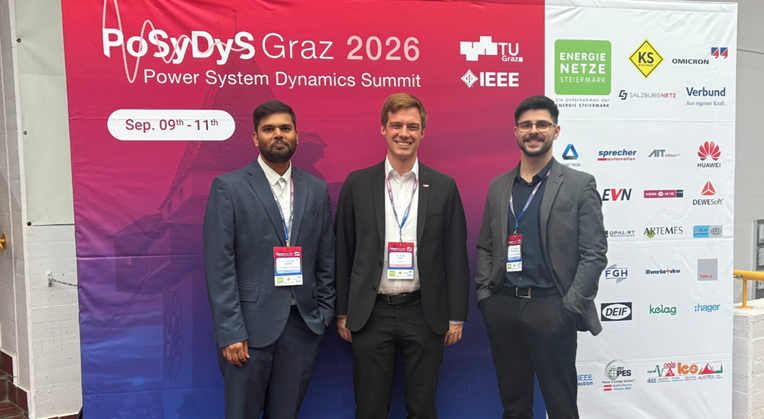
LENA at the PoSyDyS in Graz, Austria
The first edition of the Power System Dynamics Summit (PoSyDyS) 2026 took place from September 9–11 at Graz University of Technology, Austria. LENA was represented by João Pedro Cipriani and Yashwanth Akuthota. With around 100 participants, two opening keynotes, and 14 technical sessions, the conference offered a compact and highly focused setting on weak grids and converter-dominated power systems, with substantial overlap with ongoing research at LENA. The small format encouraged detailed technical discussions and follow-up exchanges throughout the three-day programme.
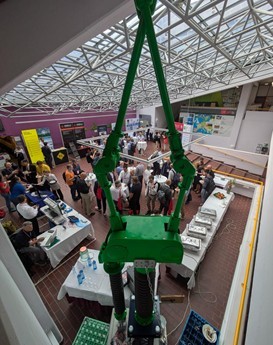
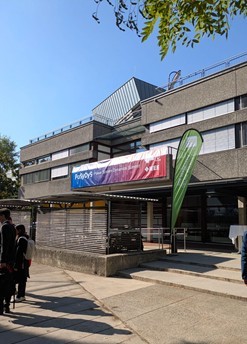
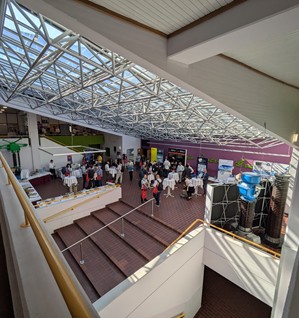
 conf1 (Bild 1 von 10) » Vorwärts « Zurückconf2 (Bild 2 von 10) » Vorwärts « Zurückconf3 (Bild 3 von 10) » Vorwärts « Zurückdinner (Bild 4 von 10) » Vorwärts « Zurückgraz1 (Bild 5 von 10) » Vorwärts « Zurückgraz2 (Bild 6 von 10) » Vorwärts « Zurückgraz3 (Bild 7 von 10) » Vorwärts « Zurückgraz4 (Bild 8 von 10) » Vorwärts « Zurückgraz5 (Bild 9 von 10) » Vorwärts « Zurückgraz6 (Bild 10 von 10)
Contributions
LENA's two contributions addressed complementary aspects of grid-forming converter operation and stability.
João Pedro Scherer Cipriani presented “Region of Attraction Analysis for Transient Stability of Current-Limited Grid-Forming Inverters,” co-authored with Ricardo Bortoluzzi Morim, Christoph Sauer, João Victor Lopes Rosa, Martin Wolter, and Humberto Pinheiro. The work investigated the stability of GFM converters under adaptive virtual-impedance current limitation, showing that activation of the limiter can substantially reduce the estimated stability region and corresponding fault-clearing margin. The presentation was followed by an extensive discussion with session chair Ziqian Zhang from TU Graz, whose research closely overlaps with the topic.
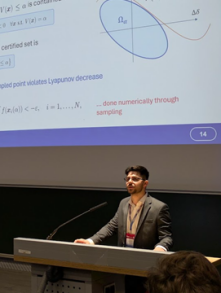
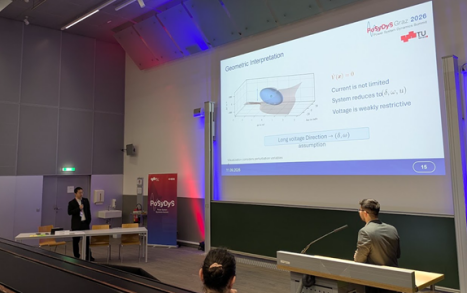
Figure 1: João Pedro Scherer Cipriani during his presentation at PoSyDyS 2026.
Yashwanth Akuthota, a master’s student at LENA, presented “Prequalified Grid-Forming VSM for Instantaneous Reserve with Black-Start Capability,” co-authored with Christoph Sauer, Gabriel Maier Cocco, João Pedro Scherer Cipriani, Martin Wolter, and Humberto Pinheiro. The study evaluated whether a VSM-based converter prequalified for German frequency ancillary services could also support black-start and power-system restoration. Using a modified IEEE 14-bus system, the same control framework was shown to remain applicable through blackout, restoration and resynchronization, and subsequently resume frequency-service operation without controller retuning. The contribution was presented in the session “Intentional Islanding and Grid Restoration”. The LENA colleagues also had the chance to discuss Real Time Simulation challenges related to the paper with the OPAL-RT team, present at the event.
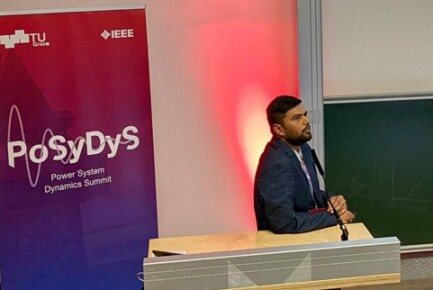
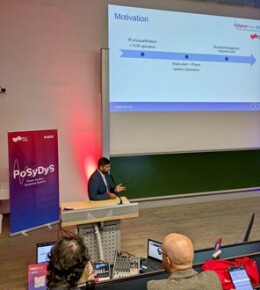
Figure 2: Yashwanth Akuthota presenting at PoSyDyS 2026.
Conference Highlights
A distinctive feature of PoSyDyS was its strong connection to the Austrian electricity sector. The opening keynotes, together with the broad participation of system operators, utilities, manufacturers, and technology providers, brought a practical system perspective to discussions on grid-forming technologies and the challenges of increasingly converter-dominated grids.
The technical programme also overlapped closely with ongoing research at LENA. Several presentations developed into broader discussions on how practical converter limitations, controller implementation, and modelling assumptions affect the interpretation of dynamic behaviour and stability. This provided useful opportunities to compare complementary approaches and identify common questions for further work.
The compact format was particularly valuable for scientific exchange beyond the formal sessions. The discussion on region-of-attraction analysis continued in a follow-up meeting with Prof. Ziqian Zhang from TU Graz and Benedikt Grüger from TU Darmstadt, and the exchange has since continued by email. João and Yashwanth also had the opportunity to connect with Dr.-Ing. Yonggang Zhang, a former member of the LENA Chair, and Ph.D.student Philipp Hackl from the TU Graz organizing team, whom Yashwanth had previously met at MELECON 2026 in Cairo.
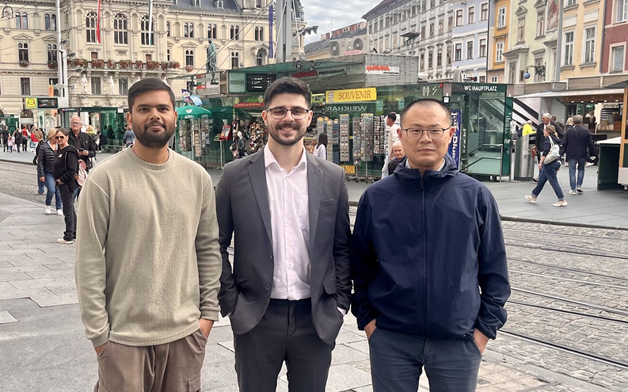
Figure 3: João Pedro Cipriani and Yashwanth Akuthota with Dr.-Ing. Yonggang Zhang, a former member of LENA chair.
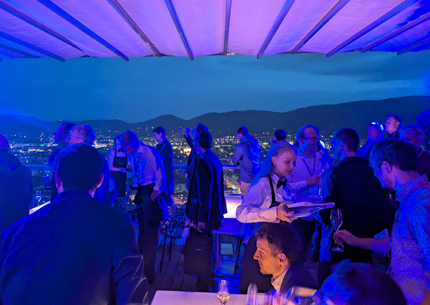
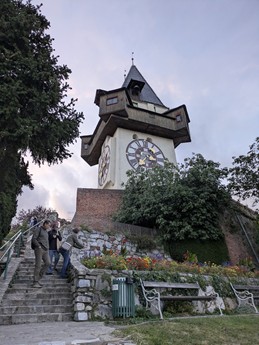
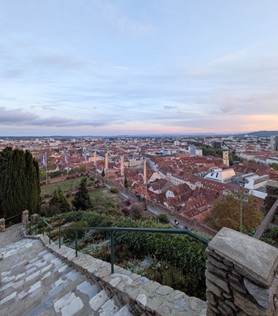
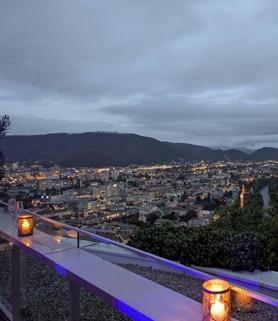
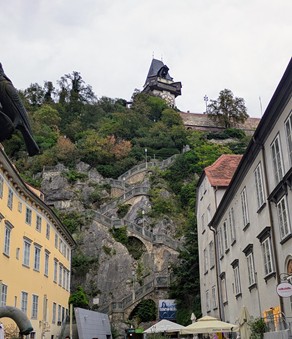
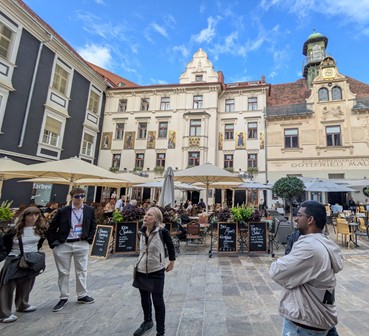
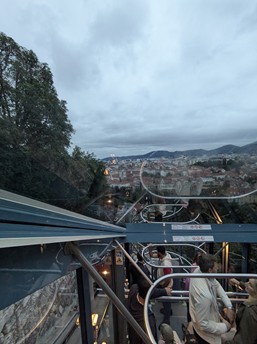
A particularly welcome spontaneous addition was a visit to the Nikola Tesla High Voltage Laboratory at TU Graz. The name carries a fitting connection to the university’s history: Nikola Tesla studied at the Technical College in Graz, the predecessor of today’s TU Graz, in the 1870s. The conference dinner at the Schlossberg and the guided city tour on the final afternoon provided further opportunities for informal exchange and offered participants a chance to experience Graz beyond the university campus. Together, the city, TU Graz, and the closely connected conference community provided an especially pleasant setting for the first edition of PoSyDyS.
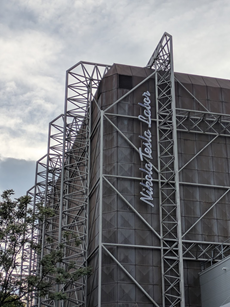
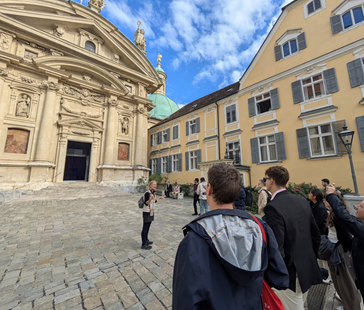
Figure 4: The activities included a visit to the Nikola Tesla High Voltage Laboratory, a guided tour to the Graz city center and guided tour and diner at the Schlossberg restaurant.
Acknowledgement
The LENA Chair would like to thank the PoSyDyS organizers and the Institute of Electrical Power Systems at TU Graz for the excellent organization and welcoming atmosphere. Following a successful first edition, we were pleased to hear about plans to continue PoSyDyS and wish the organizers every success in developing the summit further.